


UN Mission: Economic Track Recommendations Provide a Framework for Sustainable Economic Reform in Libya
Pulbished on: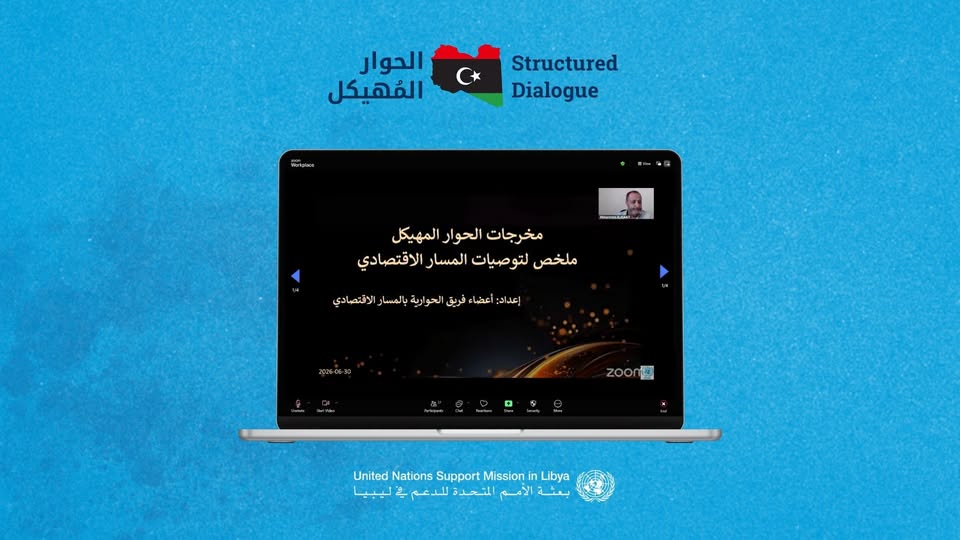
Tripoli, July 2, 2026 (LANA) – Members of the Economic Track of the Structured Dialogue, during a live online discussion with participants from across the country, reviewed the track's recommendations for addressing chronic economic challenges. They emphasized that the proposed reforms aim to enhance economic stability and build a more diversified and sustainable economy. They also clarified that the successful implementation of these reforms depends on achieving political consensus, strengthening and unifying institutions, and improving access to reliable economic data, according to a statement published by the United Nations Support Mission in Libya (UNSMIL) on its official page Wednesday evening.
Members of the track, Abdulrahim Al-Shaibani, Dr. Hamida Abu-Runiya, and Dr. Najia Al-Buazi, explained that the track's work included evaluating the performance of the Libyan economy from 2012 to 2025 and identifying the most prominent structural imbalances, primarily the excessive reliance on oil revenues, the high public debt, the increasing current government spending, the weakness of development investment, and the lack of transparency and reliable economic data. They warned that the continuation of these conditions without genuine reforms will increase pressure on public finances, foreign currency reserves, and the value of the Libyan dinar.
They indicated that the recommendations focused on six main pillars: public finance governance, governance of the oil and energy sectors, economic restructuring and diversification, balanced regional development and social justice, economic policy reform, and enhancing transparency and accountability. They emphasized that these pillars represent an integrated reform package, each supporting the others, which will enhance the efficiency of institutions and financial management, expand the role of the private sector, and reduce dependence on oil.
The discussion also addressed proposals to enhance development across various regions by supporting decentralization, improving public services and infrastructure, expanding opportunities for youth, encouraging entrepreneurship, and aligning educational outcomes with labor market needs. The importance of digital transformation and artificial intelligence in supporting economic development and capitalizing on future opportunities was also highlighted, according to the same source.
During the question-and-answer session, participants discussed several issues related to mechanisms for implementing the recommendations, regional development, managing foreign exchange reserves, digital transformation, harnessing artificial intelligence for development, and supporting local economic initiatives.
Members of the dialogue emphasized that while the recommendations are not legally binding, they represent an evidence-based framework that governments and institutions can use to guide future economic policymaking.
Approximately 120 Libyans from across the country participated in the dialogue, including men, women, youth, people with disabilities, and representatives of diverse cultural and linguistic groups. The participants began their meetings in December 2025, holding 18 in-person and virtual sessions across four tracks: national reconciliation and human rights, security, the economy, and governance.
On June 7, the members of the four tracks presented their findings to approximately 200 participants, including members of the structured dialogue, representatives of the diplomatic corps in Libya, and the United Nations Support Mission in Libya (UNSMIL).
The full recommendations are available on the UNSMIL website.
=Lana=