


With International Participation, Second Edition of the Permanent Libyan Economic Forum Kicks Off in Tripoli Under the Slogan “Invest in Libya”
Pulbished on: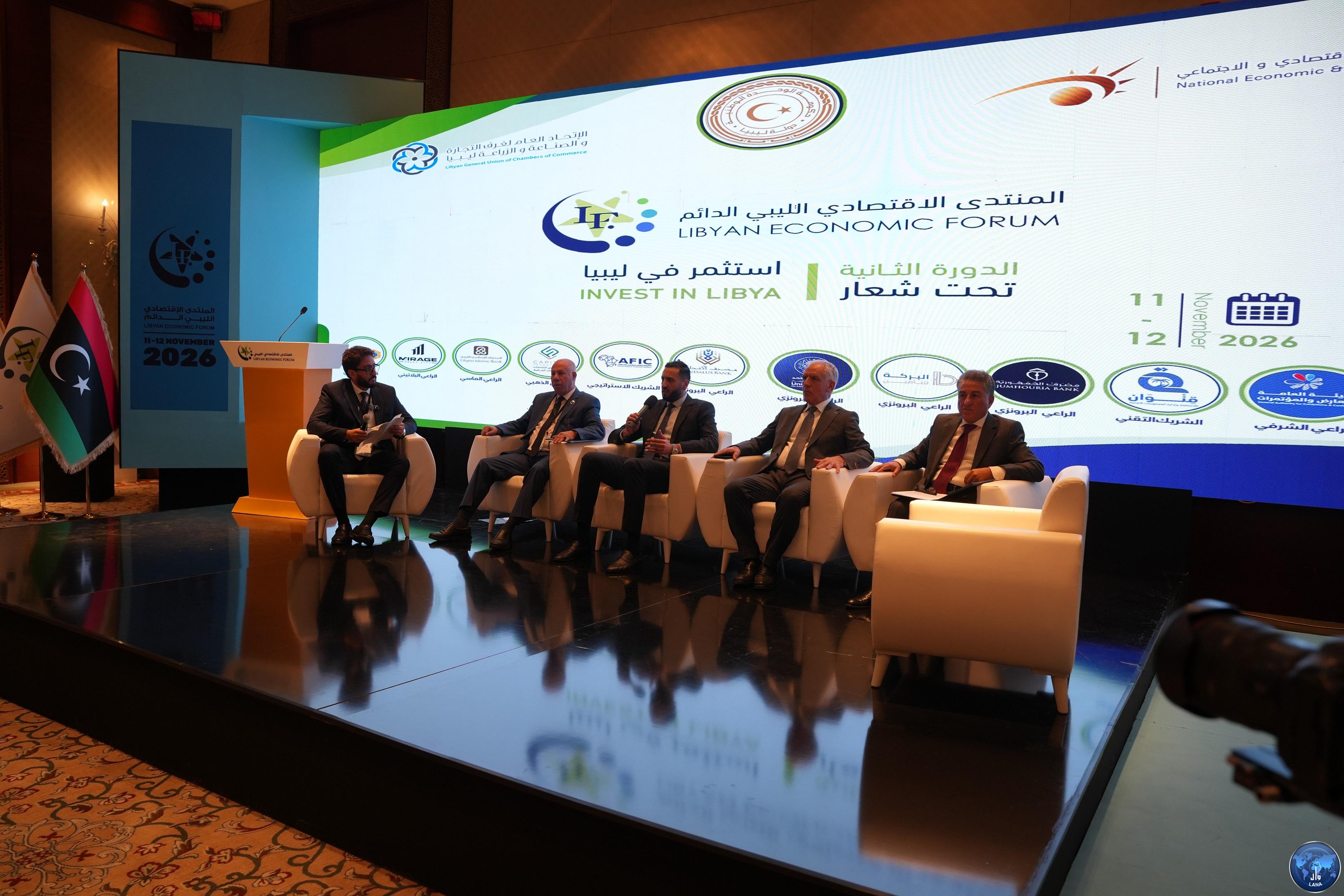
Tripoli, November 11, 2026 (LANA) – The second edition of the Permanent Libyan Economic Forum kicked off on Wednesday at the Lancaster Hotel in the capital, Tripoli, under the slogan “Invest in Libya,” with the participation of local and international institutions and organizations, economic experts, businessmen, and representatives of companies from Libya and several other countries.
The forum is overseen by the National Council for Economic and Social Development and organized by the General Union of Chambers of Commerce, Industry and Agriculture, with the participation of experts from Malaysia, the Sultanate of Oman, Jordan and France, alongside officials and representatives of economic institutions and the business sector.
The opening ceremony was attended by Deputy Prime Minister of the Government of National Unity, Salem Al-Zadma, several members of the House of Representatives, representatives of diplomatic missions accredited to Libya, the Chairman of the Management Committee of the General Union of Chambers of Commerce, Industry and Agriculture, the Director General of the National Council for Economic and Social Development, as well as a number of ministers and officials.
The forum aims to support efforts to develop the Libyan economy, benefit from international experiences and specialized expertise, and strengthen partnerships between the public and private sectors. It also seeks to discuss economic policies and the challenges facing their implementation, while working to diversify sources of income, enhance the competitiveness of the national economy and achieve comprehensive development.
In his address during the opening ceremony, Deputy Prime Minister Salem Al-Zadma stressed the importance of unifying visions regarding the future of the Libyan economy, noting that the current phase requires a clear economic vision based on diversifying sources of income, improving the investment environment, and transforming national resources and potential into productive opportunities and sustainable development projects.
Al-Zadma emphasized the need to achieve balanced regional development across all parts of Libya and make use of the country's economic and strategic advantages in a manner that strengthens economic integration and reinforces Libya's position as a gateway for trade and investment and an economic bridge between Africa and Europe.
He added that the government looks forward to the forum's outcomes in providing practical visions and recommendations and establishing a platform for dialogue between public and private institutions, contributing to the development of programmes that support reform and development efforts and meet the aspirations of the Libyan people and future generations.
During the opening activities, the National Council for Economic and Social Development presented a visual presentation on the Economic Growth and Income Diversification Programme. The presentation addressed several vital sectors, including energy, oil, industry, agriculture and food industries, while highlighting Libya's strategic location and its potential as a commercial link between Africa and Europe.
The General Union of Chambers of Commerce, Industry and Agriculture also presented a visual overview of digital transformation and the unified digital platform for chambers of commerce across Libya, outlining the registration mechanisms and services provided by the platform.
During the forum, the launch of the second phase of membership services was announced. The Deputy Prime Minister and the Chairman of the General Union of Chambers of Commerce, Industry and Agriculture also announced the commencement of operations of the unified digital system for chambers of commerce, industry and agriculture across the country.
Following the opening ceremony, the forum's academic sessions commenced and are scheduled to continue over two days.
The first day's sessions discuss international and geopolitical changes and their implications for the local and global economies, as well as the national strategic vision.
The second day's sessions will address the financial and banking sector and its role in strengthening economic stability and financing development, in addition to digital transformation and its role in enhancing the competitiveness of the Libyan economy.
...(LANA)...