


National Council for Freedoms and Human Rights Calls for Review of Unified Salary Scale
Pulbished on: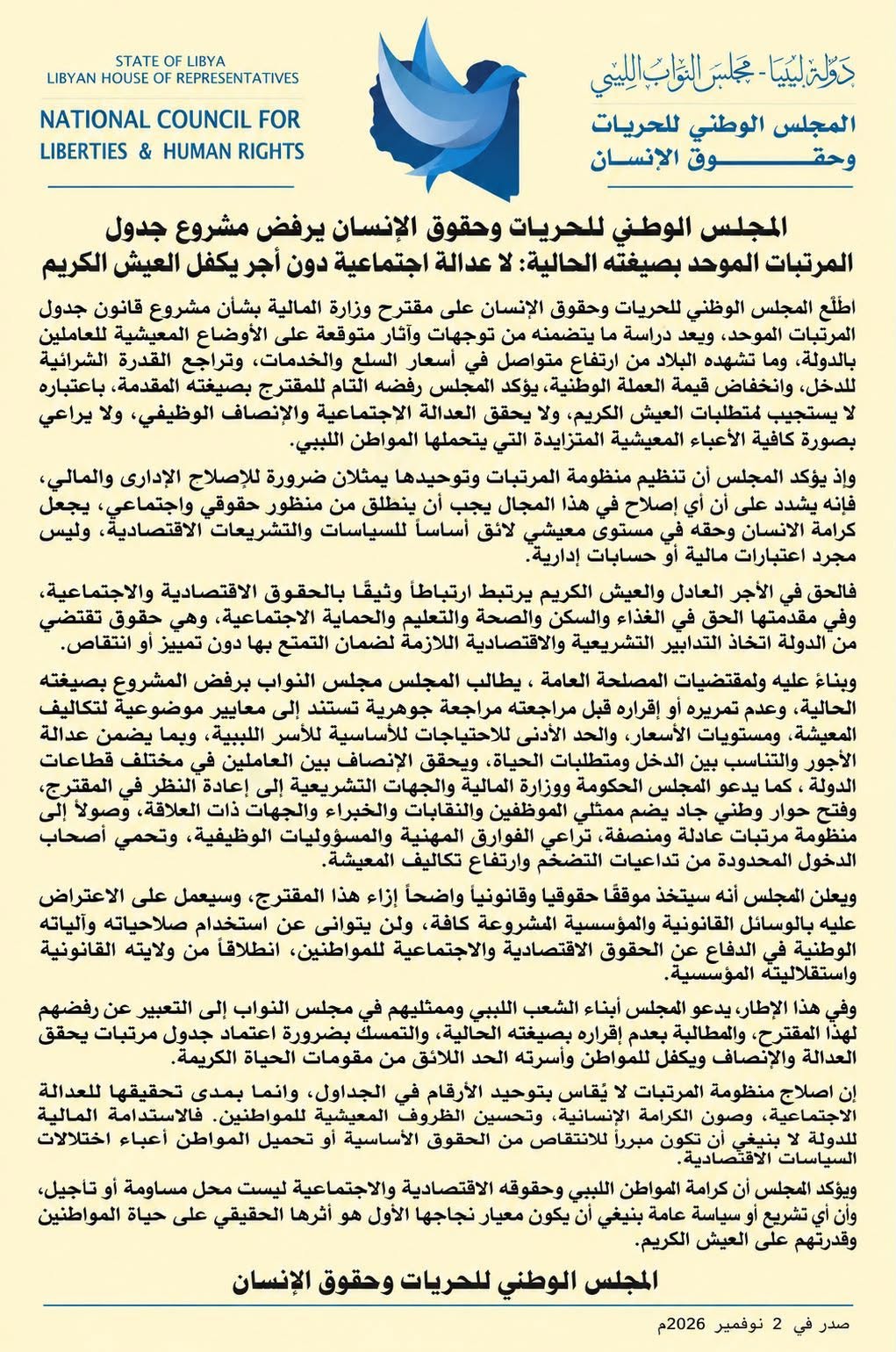
Tripoli, November 2, 2026 (LANA) – The National Council for Freedoms and Human Rights has announced its outright rejection of the Ministry of Finance’s proposed draft law on the unified salary scale in its submitted form. The Council stressed that, given the proposal’s provisions and anticipated implications, it does not adequately take into account the living conditions of public sector employees, amid continuously rising prices of goods and services, declining purchasing power, and the depreciation of the national currency.
In a statement issued on Monday, the Council explained that unifying the salary system is necessary for administrative and financial reform. However, any reform in this area must be based on a human rights and social perspective that places human dignity and the right to an adequate standard of living at the forefront of priorities, rather than focusing solely on financial considerations and administrative calculations.
The Council stressed that the right to fair wages and a dignified life is closely linked to economic and social rights, particularly the rights to food, housing, healthcare, education, and social protection. This requires the adoption of policies and legislation that safeguard these rights and ensure they are not undermined.
The Council called on the House of Representatives to reject the draft law in its current form and refrain from passing it before it undergoes a comprehensive review based on objective standards that take into account the cost of living, price levels, and the basic needs of Libyan families. This, it said, would ensure wage fairness, maintain a balance between income and living expenses, and promote equity among employees across various state sectors.
It also urged the government, the Ministry of Finance, and legislative authorities to reconsider the proposal and launch a serious national dialogue involving employee representatives, trade unions, experts, and relevant stakeholders. The aim would be to establish a fair salary system that takes into account professional differences and job responsibilities while protecting low-income earners from the effects of inflation and rising living costs.
The Council affirmed that it would adopt a clear human rights and legal position on the proposed legislation and work to challenge it through legitimate legal and institutional channels, exercising its powers and national mechanisms to defend citizens’ economic and social rights, in accordance with its legal mandate and institutional independence.
The Council also called on citizens and their representatives in the House of Representatives to express their positions on the proposal, demand its review, and oppose its adoption in its current form. It stressed the importance of maintaining a salary scale that ensures fairness and equity and guarantees citizens and their families the basic requirements for a dignified life.
Concluding its statement, the Council emphasized that reforming the salary system should not be measured merely by standardizing figures in salary tables, but rather by the extent to which it achieves social justice, safeguards human dignity, and improves citizens’ living conditions. It noted that the state’s financial sustainability must go hand in hand with protecting fundamental rights and must not become a justification for placing the burden of economic imbalances on citizens.
The Council further affirmed that the dignity of Libyan citizens and their economic and social rights remain fundamental principles that must guide legislation and public policies, stressing that their actual impact on people's lives and their ability to enjoy a dignified standard of living should serve as a key measure of their success.
...(LANA)...