


The State Council rejects Law No. (4), affirming that elections are a national imperative and that the rules governing them must be established through institutional consensus.
Pulbished on: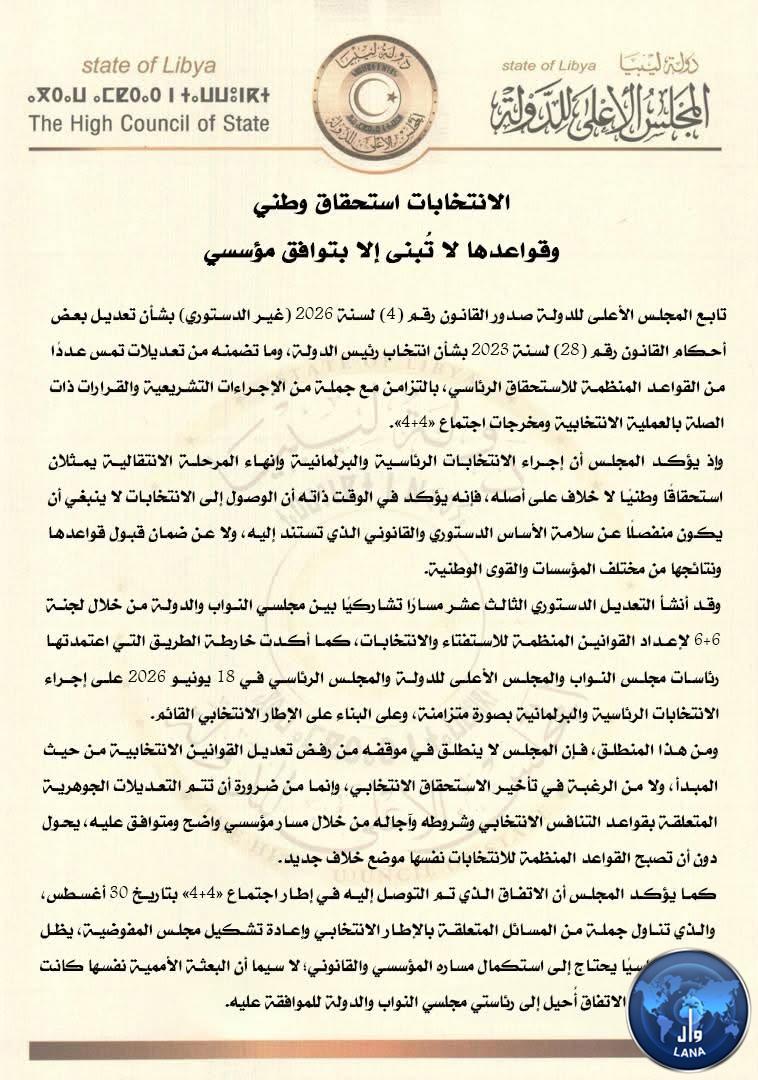
Tripoli, September 29, 2026 (LANA) – The High Council of State has deemed Law No. (4) of 2026 unconstitutional. It stated that the amendments to certain provisions of Law No. (28) of 2023—which concerns the election of the Head of State—infringe upon several rules governing the presidential election process. This development coincides with a series of legislative measures and decisions related to the electoral process and the outcomes of the "4+4" meeting.
In a statement issued on Monday evening, the Council emphasized that while holding presidential and parliamentary elections and ending the transitional phase is a national imperative—the necessity of which is undisputed—the path to these elections must not be divorced from the integrity of the underlying constitutional and legal framework, nor from ensuring that the rules and results are accepted by the various national institutions and forces. The Council noted that the 13th Constitutional Amendment established a participatory process between the House of Representatives and the High Council of State—via a committee tasked with drafting laws governing the referendum and elections. Furthermore, the roadmap adopted on June 18, 2026, by the leadership of the House of Representatives, the High Council of State, and the Presidential Council affirmed the need for simultaneous presidential and parliamentary elections and for building upon the existing electoral framework. Accordingly, the Council’s position—rejecting amendments to electoral laws—stems neither from an objection to such amendments in principle nor from a desire to delay the elections. Rather, it is based on the necessity that any substantive amendments regarding the rules, conditions, and timelines of electoral competition be conducted through a clear, agreed-upon institutional process, thereby preventing the election regulations themselves from becoming a new source of dispute.
The Council emphasized that the agreement reached during the "4+4" meeting on August 30—which addressed various issues concerning the electoral framework and the restructuring of the High National Elections Commission—remains a political understanding requiring the completion of its institutional and legal procedures. This is particularly relevant given that the UN mission itself confirmed the agreement had been referred to the leadership of both the House of Representatives and the High Council of State for approval. In its statement, the Council reaffirmed its commitment to: the right of Libyans to choose their authorities through free, fair, and transparent elections; respect for the constitutional and institutional path governing electoral legislation; the principle of not transforming political understandings into definitive legislative rules prior to the completion of the necessary institutional frameworks; and the establishment of an electoral legal framework that enjoys the broadest possible consensus, thereby safeguarding the elections against challenges to their legitimacy or results.
The Council of State called upon the House of Representatives to complete institutional consultations regarding the electoral framework. It also urged the United Nations Support Mission in Libya (UNSMIL) to fulfill its facilitating role in a manner that respects Libyan institutions and their constitutional processes, ensuring that the mission of facilitating consensus does not devolve into replacing one institutional path with another.
Concluding its statement, the Council reiterated its readiness to engage in any serious and responsible dialogue leading to stable, agreed-upon electoral rules, a unified executive authority, and elections that bring an end to the transitional phase rather than generating new disputes over the legitimacy of their outcomes. It noted that disagreements over the "rules of the road" should not turn into disputes over the nation's ultimate goal; the elections to which Libyans aspire deserve a legal framework that protects them both before they are held and regarding their results afterward.
...(LANA)...