


Members of the Security Track Discuss Security Sector Reform
Pulbished on: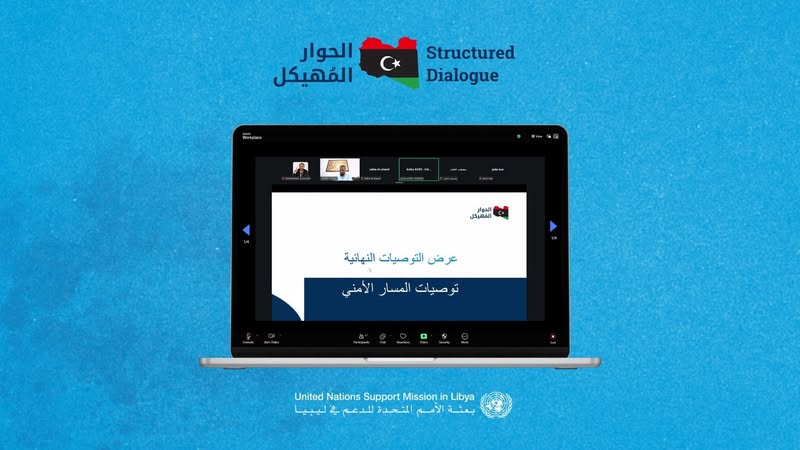
Tripoli - July 4, 2026 (LANA) – The United Nations Support Mission in Libya (UNSMIL) announced on Saturday that members of the Security Track in the Structured Dialogue held an online meeting last Thursday to discuss recommendations aimed at advancing security sector reform efforts, strengthening national stability, and creating the necessary conditions for achieving sustainable peace and holding credible elections in Libya.
UNSMIL added that the session was opened by Musab Al-Abed, a member of the House of Representatives and a member of the Security Track, who presented the track's vision, structure, and methodology. He explained that the track seeks to contribute to developing a national vision for enhancing security and stability, supporting the electoral process, preventing conflicts, and maintaining the ceasefire. He also pointed to the importance of developing a unified national security and military doctrine based on the rule of law and supporting state-building efforts.
The security track included representatives from across Libya, including military, security, political, legal, and community figures, as well as representatives of civil society, with the active participation of women, youth, and persons with disabilities. The track adopted a phased approach, moving from assessments and addressing urgent security challenges to long-term institutional and strategic issues, through four interconnected pillars: electoral security; conflict prevention and ceasefire maintenance; security sector governance; and the unification of the military and security institutions.
In presenting the recommendations related to electoral security, Dr. Jaziyah Issa, a member of the security track, emphasized that the success of the elections requires political consensus, a clear legal framework, unified security arrangements, and guarantees that ensure the integrity of the electoral process and the acceptance of its results. The recommendations focused on strengthening coordination with the High National Elections Commission, enhancing oversight of election security, and supporting the participation of civil society, women, and youth in the electoral process.
Regarding conflict prevention and maintaining the ceasefire, Security Track member Salha Al-Sharif emphasized that the recurring conflicts in Libya stem from a confluence of political, security, institutional, and societal challenges. She presented recommendations calling for support for unified governmental, security, and military institutions; strengthening the role of the Joint Military Commission (5+5); developing national mediation and early warning mechanisms; supporting local mediation initiatives; and advancing reintegration programs for armed groups and conflict-affected communities.
In presenting recommendations related to security sector governance, Security Track member Major General Hossam Kaabar stressed that security challenges in Libya are not limited to operational aspects but also encompass legal, institutional, and oversight shortcomings. He highlighted recommendations calling for the establishment of a comprehensive national framework for security sector governance; the restructuring and unification of security institutions; the strengthening of legislative oversight and accountability mechanisms; and institutional capacity building.
Discussions on unifying the military and security institutions underscored that the continued institutional division weakens state authority and undermines peacebuilding and development efforts. The recommendations called for ending political divisions, harmonizing legal and institutional frameworks, expanding the role of the Joint Military Commission, implementing disarmament, demobilization, and reintegration (DDR) programs, and establishing a specialized mechanism to monitor implementation and measure progress.
During the discussion, participants emphasized that the main obstacle to security sector reform is political rather than technical, noting that the lack of political will has hampered the implementation of previous initiatives. Several participants called for clear implementation mechanisms and measurable indicators to ensure that the recommendations translate into tangible progress.
Participants also raised questions about the neutrality of security institutions during the upcoming elections, the management of armed groups operating outside state authority, and the steps and timelines necessary to unify the military and security institutions under neutral civilian leadership. Others stressed the importance of strengthening accountability and protecting human rights during the transitional phase, and ensuring that security sector governance is guided by a purely national strategic vision.
Several interventions also highlighted the links between security, economic development, infrastructure protection, and youth engagement.
The discussions concluded with a broad agreement that achieving lasting peace and stability in Libya cannot be accomplished through security arrangements alone. Participants emphasized the need to create an enabling environment for elections, strengthen governance and accountability, develop conflict prevention mechanisms, and establish unified and professional security and military institutions operating under the authority of a single state and a unified legal framework.
The Mission stated that approximately 120 Libyans from across the country participated in the structured dialogue, including men, women, youth, persons with disabilities, and representatives of cultural and linguistic groups. Since December 2025, participants have held 18 in-person and virtual sessions across four tracks: national reconciliation and human rights, security, the economy, and governance.
On June 7, members of all tracks presented their outputs to approximately 200 participants, including members of the structured dialogue, representatives of the diplomatic corps in Libya, and the UN Support Mission in Libya (UNSMIL) team. The final report, which includes the structured dialogue's recommendations, is available for download on the UNSMIL website.
=Lana=