


National Information Technology Day Celebrations Launched
Pulbished on: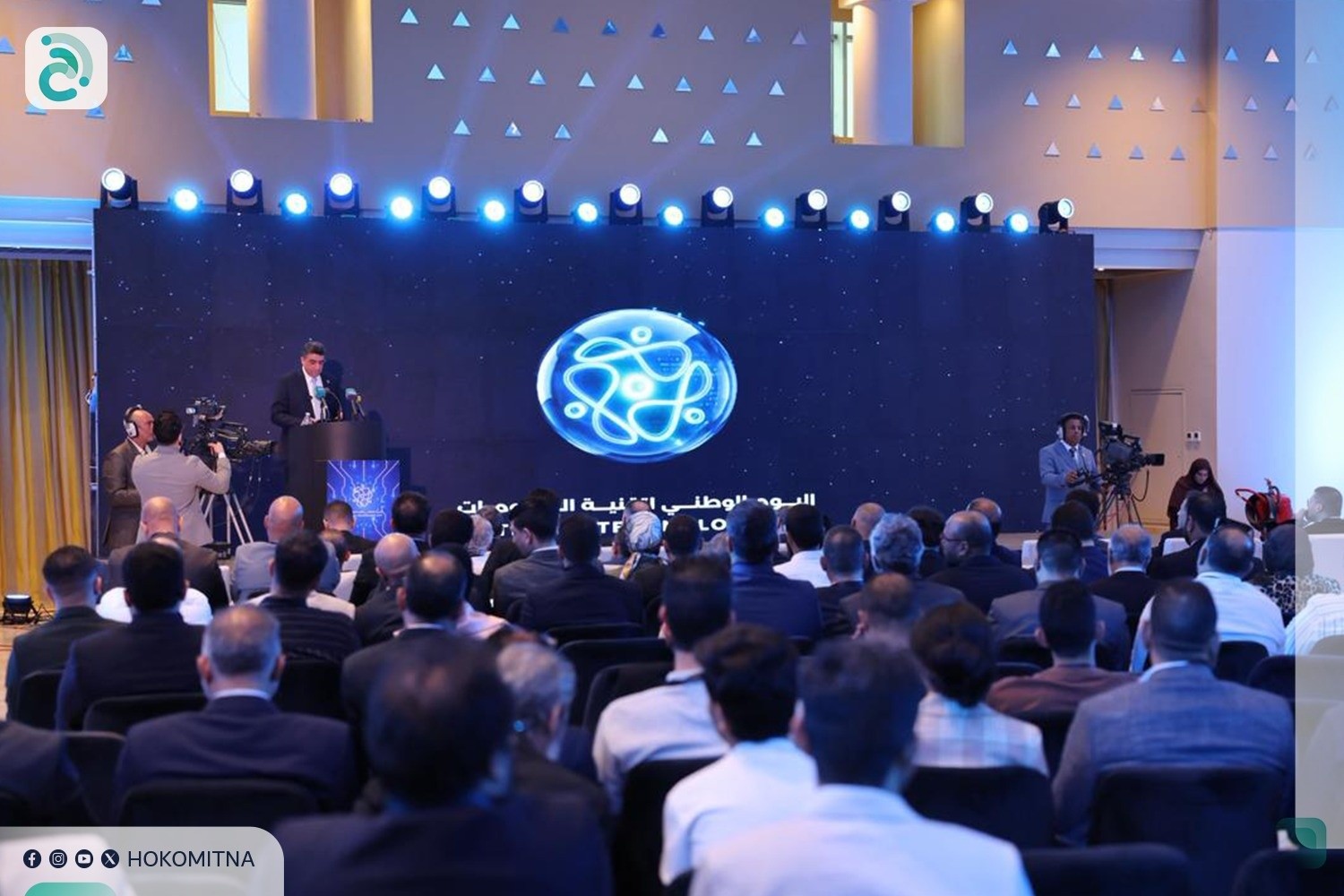
Tripoli, June 1, 2026 (LANA) – The National Information Technology Day celebrations were held today, Monday, in Tripoli, in implementation of Prime Minister's Decree No. (79) of 2021, which designated June 1st as National Information Technology Day.
The events were attended by the Prime Minister of the Government of National Unity, Abdul Hamid Dbaiba, the Head of the Audit Bureau, Khaled Shakshak, the Minister of Youth, Haitham Al-Zahaf, the Head of the National Technology Foundation, the Head of the National Economic Development Board, and the Chairman of the Libyan Telecommunications Holding Company, along with a number of interested parties, experts, and specialists in the field.
In his address during the National Information Technology Day celebrations, the Head of the Audit Bureau, Khaled Shakshak, emphasized that this day has become a platform for bringing together national minds, expertise, and competencies, and an opportunity to highlight the pivotal role of technology in building more transparent and sustainable institutions.
He stated that their participation for the third consecutive year in this event stems from the conviction that digital transformation has become a national imperative, dictated by the demands of modern development, the challenges of public administration, and citizens' aspirations for more efficient, higher-quality, and more effective services and institutions.
Shakshak added that the world has witnessed a radical shift in the concept of oversight and public administration in recent years, with data and smart technologies becoming key tools in decision-making and promoting integrity. From this perspective, the Libyan Audit Bureau has placed digital transformation among its strategic priorities, considering it a fundamental pillar for developing oversight work and modernizing its tools and mechanisms, in line with modern international standards for supreme audit institutions.
He noted that the Audit Bureau launched a pioneering project at the beginning of this year: the development of a specialized institutional artificial intelligence model called “Diwan Bot.” Designed and developed entirely by young national talent, the model aims to support auditing, review, and oversight analysis, expedite access to information, improve the quality of oversight outputs, and empower auditors to utilize AI tools within a secure environment that adheres to the highest standards of digital governance and cybersecurity. He emphasized that it will not replace human expertise but rather serve as a supportive and enhanced tool.
The President of the Audit Bureau also announced the launch of the “Athar Platform” for smart oversight. He explained that it is designed as an integrated system that manages the oversight cycle in all its forms and stages, from planning and commissioning to implementation and follow-up, culminating in the preparation of results and recommendations.
Shakshak emphasized that the Audit Bureau does not view the “Athar” platform merely as a technological project or a new oversight system, but rather as a strategic milestone within a broader framework for establishing digital governance in Libyan state institutions. He described it as an advanced national model for leveraging technology to enhance transparency, improve institutional performance, and enhance the quality of decision-making, thereby contributing to the modernization of oversight work in all its forms and stages.
For his part, Ali Al-Farjani, Chairman of the Holding Company for Communications and Information Technology, affirmed that the communications and information technology sector has become one of the most important pillars of economic and administrative development, a key tool for improving government services, empowering youth, supporting investment, and strengthening Libya’s position in the global digital economy.
In his address, he stated that the Holding Company for Communications and Information Technology, in cooperation with its subsidiaries, continues to work on developing the digital infrastructure, expanding communications services, and enhancing the state’s readiness to keep pace with rapid technological changes.
Al-Farjani announced the imminent launch of the “My Country” project, which aims to provide integrated digital government services to citizens, representing a significant step towards building a modern and more efficient digital government.
The launch of the unified national database was also announced. This database will form the basis for data integration among state institutions, improve service quality, and support decision-making according to the highest technical and security standards.
On the sidelines of these events, which took place in 50 locations across the country, two memoranda of understanding for cooperation were signed: the first between the Ministry of Youth and the National Technology Foundation, and the second between the Supreme Committee for Implementing Strategic Cooperation to Combat Corruption and the National Technology Foundation.
=Lana=