


Economic Editor at (LANA): The Memorandum of Understanding between the National Oil Corporation and the American company Chevron: Between Ambitions and Challenges – A Reading
Pulbished on: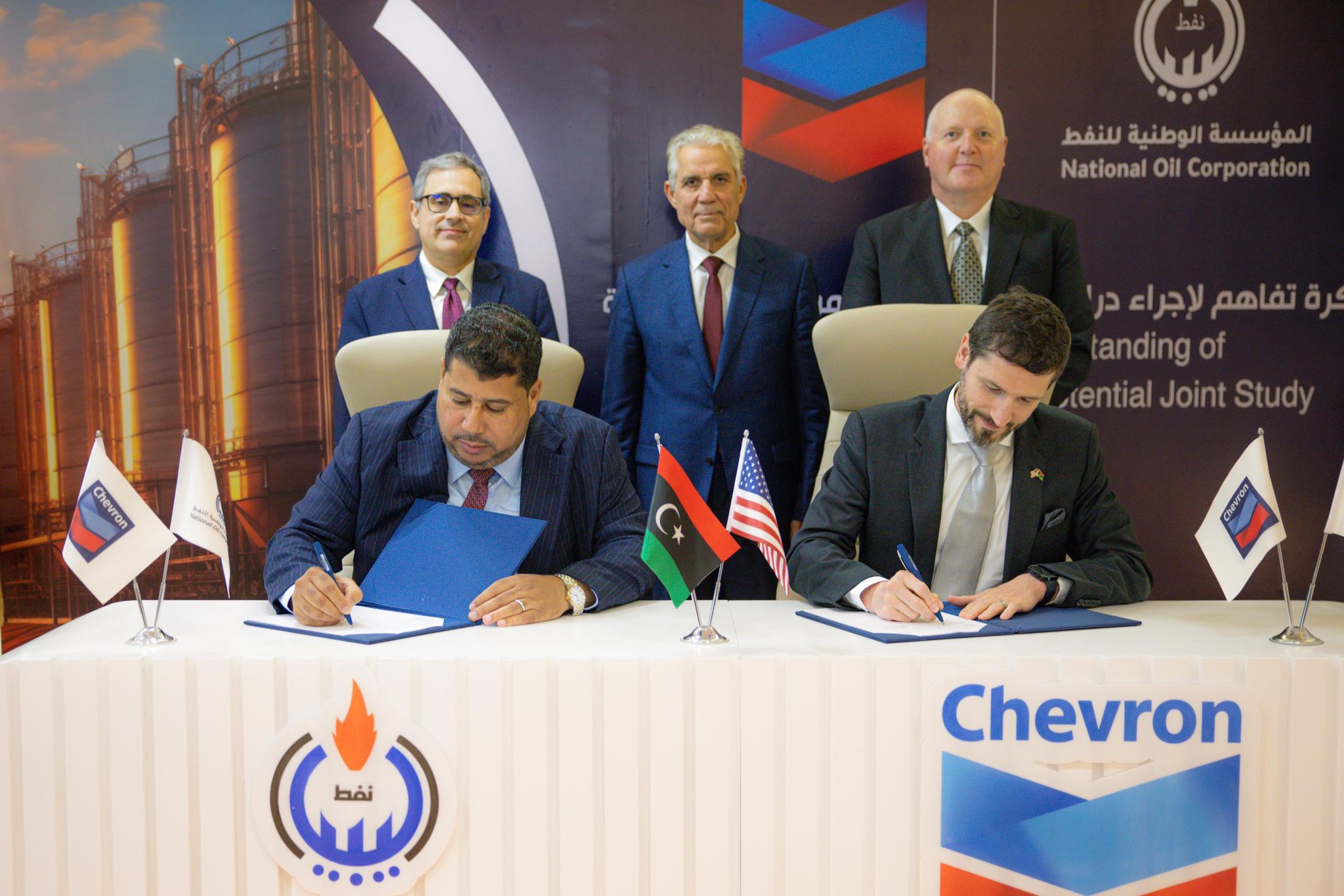
Tripoli, April 30, 2026 (LANA) – The National Oil Corporation (NOC) signed a memorandum of understanding (MoU) with the American company Chevron to conduct a joint study aimed at assessing the potential of unconventional shale oil and gas resources in several sedimentary basins within Libya.
According to the terms of the MoU, published on the NOC website on Tuesday, the study will cover three sedimentary basins: Sirte, Murzuq, and Ghadames. Technical teams from both sides will analyze the available data and evaluate potential opportunities for developing the resources available in these basins.
NOC data indicates that gas reserves are estimated at approximately 123 trillion cubic feet, in addition to oil reserves of approximately 18 billion barrels. This suggests promising potential that will bolster national reserves and enhance Libya's role in energy markets.
The Chairman of the NOC Board of Directors, Masoud Suleiman, affirmed that this MoU is an exceptional step that will pave the way for other similar MoUs and agreements aimed at supporting Libya's oil reserves.
Suleiman explained that this is the first joint study in Libya to assess unconventional resources, noting that the agreement will allow Libyan technical personnel to work alongside Chevron's American staff. This will enhance their practical field experience, open doors for their professional and technical development in this area, and enable them to independently undertake such tasks in the future.
Experts believe that this memorandum represents a strategic step rather than a direct economic shift in the near term. It falls within the framework of diversifying the hydrocarbon resource base by exploring unconventional potential, particularly in the Sirte, Murzuq, and Ghadames basins, areas historically known for their conventional production.
Despite the promising initial estimates of 123 trillion cubic feet of gas and 18 billion barrels of oil, these remain within the category of "potential resources" and not proven reserves ready for commercial extraction.
These experts add that, from an economic perspective, this step is not expected to yield a quick return for the Libyan economy, which is going through a critical phase characterized by volatile oil revenues and weak diversification. Indeed, evaluating unconventional resources can take years, followed by massive investments in infrastructure and technologies, particularly hydraulic fracturing (fracking). This requires a stable political and security environment, a condition that has not yet been fully met.
In a related context, a number of technical and economic challenges could affect the outcome of this approach. These include the high cost of developing unconventional resources compared to the low-cost conventional oil that Libya possesses, as well as the reliance of these processes on advanced technologies such as hydraulic fracturing, which requires substantial investments and sophisticated infrastructure. According to experts, water scarcity in Libya also presents an additional challenge, given the large quantities of water required by these technologies. This may impose environmental and logistical considerations on the development of these resources.
Libya is one of Africa's richest countries in terms of hydrocarbon resources, possessing substantial oil and natural gas reserves. Proven oil reserves are estimated at approximately 48.3 billion barrels (as of 2025), representing about 2.7% of global reserves, placing Libya 10th globally. Proven natural gas reserves are estimated at approximately 53 trillion cubic feet, representing about 0.7% of global reserves.
The signing of the memorandum of understanding with the American company Chevron, despite its initial exploratory nature, reflects the National Oil Corporation's (NOC) commitment to strengthening partnerships with major international companies. This will contribute to knowledge transfer and national capacity building, while also sending a positive message to international markets about the openness of Libya's energy sector to investment. In the short term, the focus remains on maximizing the utilization of existing conventional resources.
This step can be seen as boosting the confidence of international companies in Libya's energy sector, opening doors for technology transfer and local capacity building, and positioning Libya on the map of countries considering future energy options. It also represents a proactive approach to the shifts in the global energy market, particularly given the increasing demand for gas. This memorandum is not a quick fix for Libya's economic crisis, but rather a long-term investment in resource management and expanding strategic options. However, its success, according to experts, remains contingent on Libya's ability to achieve stability, improve its investment climate, and prioritize its objectives between maximizing the use of traditional resources and developing more costly and complex alternatives.
...(LANA)...