


Al-Menfi: A single budget must be established, not a unified one.
Pulbished on: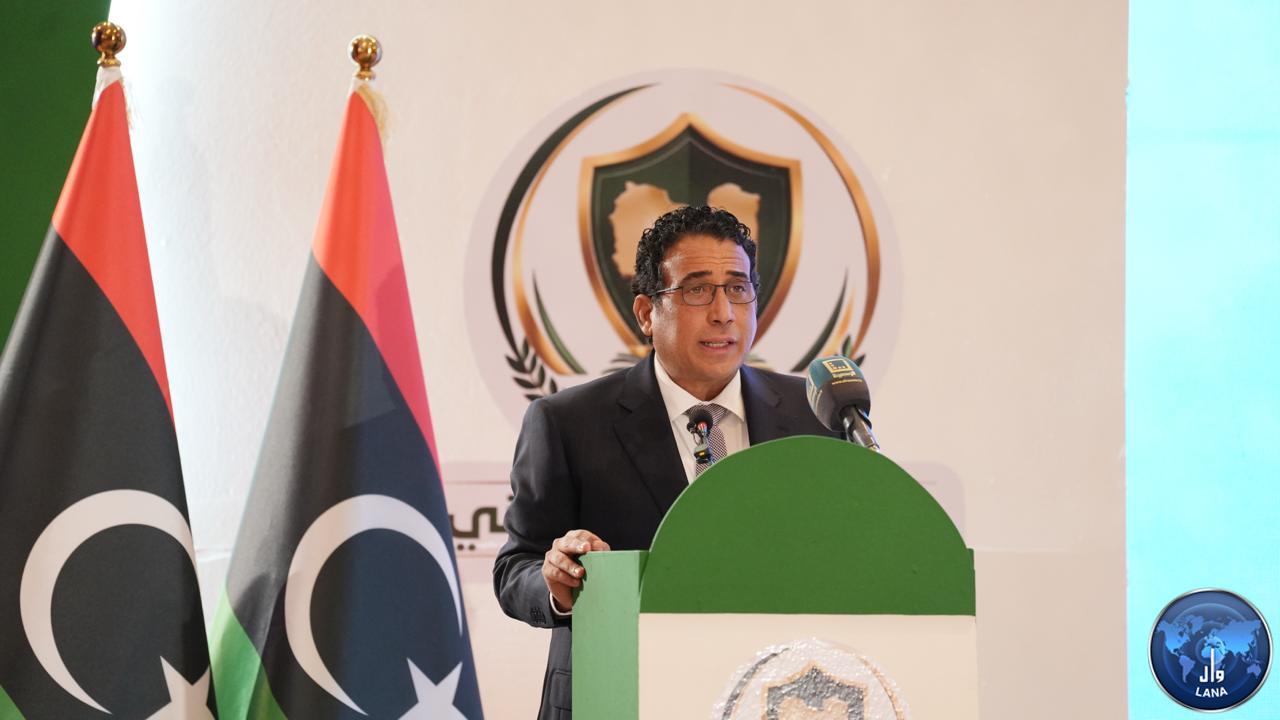
Tripoli, April 12, 2026 (LANA) – Presidential Council Head Mohammed Al-Menfi stressed the necessity of establishing a single, unified budget, not a separate one, and ensuring transparency through financial arrangements. He called for a single entity for the Central Bank, accounting, and oversight, and a sovereign national committee to monitor oil and gas contracts, given that gas is the primary and sole resource for the Libyan people. He also emphasized the need for a single channel for all revenues to be collected by the Central Bank, eliminating the involvement of local or foreign intermediaries who would otherwise share in the Libyan people's livelihood and that of their children.
This came during his address at the forum supporting the national path to combating corruption, enhancing transparency, and protecting public funds, which commenced its work today, Sunday, in Tripoli. He began by stating that the Libyan people are the rightful owners and the remaining authority on their land, after all the transient political bodies and temporary transitional phases, and the true owners of the resources and wealth of this bountiful country.
He stated that the current phase Libya is experiencing is, by all accounts, unprecedented in its history, a situation difficult to find parallels among nations. Wealth has been stolen, dreams have evaporated, and the state has been torn apart by the whims of politicians and the lust for power. The people have been exhausted by years of hardship due to corruption and the systematic plundering of their resources and the sustenance of their children.
He added that we stand today before a reality that cannot be ignored, a reality burdened by accumulated crises, the most prominent of which is corruption. Its roots run deep within the structure of the state and society. Political instability has become an inherent characteristic, not because it is an inevitable fate, but because it is a direct result of corruption, negligence, laxity, and the absence of vision and accountability. He explained that the hardship citizens are experiencing today—the deterioration of services, rising prices, and erosion of purchasing power—is no longer a passing crisis, but a harsh reality that weighs heavily on people's lives, depletes their patience, and infringes upon their dignity and their natural right to a decent life.
“Al-Menfi” asked, “How can a nation rise up when its energies are being depleted and its resources are being squandered? How can we build a strong state when bribery, favoritism, and nepotism have become the doors through which opportunities are opened, not competence or merit? How can we trust institutions where public office is exploited to achieve personal interests, while the corrupt escape punishment, transgressors are rewarded, and the honorable are excluded?”
He explained that corruption is not merely individual behavior, but a comprehensive system that thrives on forgery and extortion. It becomes entrenched when the truth is concealed, and when the authorities control the media, silencing free speech and obscuring facts. This danger is exacerbated when the role of civil society institutions—those that are supposed to be the watchdogs and the voice of the people—is absent. Decision-making at the highest levels of the state is monopolized, excluding participation and disregarding the will of the people. Corruption not only steals money but also steals hope, undermines legitimacy, and destroys trust between citizens and the state. When this trust is lost, only a vacuum remains, chaos spreads, stability collapses, and the state itself is put at risk.
In his speech, Al-Menfi addressed the situation in Libya, stating that the country has witnessed numerous understandings, counter-understandings, initiatives, agreements, slogans, and glittering titles in recent years. However, many of these were not aimed at resolving the root causes of the crisis but rather at managing it in a way that ensured its continuation, its reproduction in a new form, the prolongation of the division, the rotation of influence, the sharing of resources, and the shifting of the burden onto the citizen. What was supposed to be an entry point for reform often became a new cover for manipulation, and what was meant to be a tool for salvation became, in reality, a tool for nullifying the obligations of the division and redistributing its burdens without any real impact on people's lives, the functioning of state institutions, or the path to national stability.
He emphasized that corruption in Libya has become blatant and is no longer merely individual transgressions or isolated incidents, but rather an interconnected system that permeates the joints of the state and administration, benefits from the division, thrives on it, and resists every serious attempt at reform because it understands that ending the chaos means the end of its privileges. The establishment of a state based on institutions and the rule of law means the end of the political immunity that has long protected it. He pointed out that while billions are being squandered under various pretexts, citizens are unable to obtain their most basic rights to decent healthcare, quality education, essential services, a stable electricity supply, safe roads, and efficient governance.
Al-Menfi pointed out that it is impossible to talk about combating corruption or effectively protecting public funds in light of a fragmented institutional reality, multiple authorities, unrestrained spending without sufficient accountability, overlapping jurisdictions, and the prioritization of political interests over national necessities. The crisis in Libya is not merely a crisis of numbers, but a crisis of governance, a crisis of legitimacy, a crisis of public administration, a crisis of accountability, and a crisis of will to build a genuine state. He stressed the necessity of a unified national budget produced by unified institutions, harmonized authorities, clearly defined responsibilities, and effective oversight mechanisms. Continued spending amidst multiple centers of power and ongoing political division does not represent a comprehensive solution; rather, it could become an additional avenue for chaos, a new source of waste, and a wider conduit for the perpetuation of corruption.
He said that what I am declaring now should not be seen as political wrangling or making baseless accusations. In the past few days, I have referred to all official bodies in the country the report of the committee of economic experts, which was prepared by a select group of specialists known for their knowledge, independence, and competence. In it, they clearly emphasized the need for urgent intervention to stop the economic and financial bleeding in the country and to curb the rampant corruption that is pushing the country to the brink of economic collapse and chaos. The financial law in the country is almost paralyzed, financial oversight is incapable or inoperative, sovereign revenues are not being deposited into the state treasury, and government expenditures are not being directed to their rightful recipients. As for the Libyan dinar, it has lost nearly 80% of its purchasing power, causing inflationary waves that have thrown more than 40% of the Libyan people below the poverty line. Even the wealth of future generations is no longer safe underground from long-term contracts that do not meet the minimum legal requirements and technical standards that preserve the rights and interests of the Libyan people.
He added that the truth that must also be stated is that the extent of political paralysis, manipulation of institutions, and the entanglement of influence and money have made it difficult to take decisive action with the speed required by the gravity of the situation. This does not absolve us of responsibility, but it compels us all to understand the nature of the battle we are waging: it is a battle to reclaim the state from division, to reclaim national sovereignty from blackmail, and to recover public funds from systematic plunder.
He added that the Libyan people are not begging for their rights, nor are they asking anyone for a favor regarding what is inherently theirs. Their right to a dignified life is not a gift from anyone, and their right to a unified state, legitimate institutions, decent services, and protected public funds is not a luxury but rather the very essence of the national contract upon which the idea of the state was founded. He pointed out that the patience of the Libyan people throughout these years was not weakness, nor was it acceptance of the status quo, but rather an expression of a deep awareness of the dangers of chaos, a concern for the homeland, and a desire to avoid sliding into the unknown. Their patience must not be misunderstood, nor exploited to perpetuate further chaos, impose more deals, or deepen the reality of division and corruption.
In his address, Al-Menfi called upon the Libyan people to uphold their right to peaceful and responsible expression, to reject the legitimization of corruption, and to prevent the social, political, and moral empowerment of corrupt individuals. He urged them to reject the transformation of stolen funds into prestige or the use of illegitimate influence as public representation. He emphasized that the fight against corruption is not merely a battle waged by oversight bodies or official institutions, but also a battle for societal awareness, a moral stance, and a unified national rejection of all forms of plunder and impunity.
He cautioned that the true path out of this predicament lies not in expanding the circle of temporary solutions, nor in recycling the same bodies and arrangements, nor in postponing the crisis from one issue to another. Rather, it lies in returning to the people and respecting their free will, empowering them to elect a new legislative and executive authority through elections in which all Libyans participate, based on fair legal principles and clear national guarantees. This, he asserted, would end the political, regulatory, and economic chaos that has plagued the country and its citizens.
In concluding his speech, Al-Menfi called upon everyone—the state, society, elites, and national forces—to take action to halt this course, correct its trajectory, and salvage what remains of the opportunities for stability and a decent life. He stressed the necessity of a single, unified budget; transparency and disclosure through financial arrangements; a single entity for the central bank, accounting, and oversight; a sovereign national committee to monitor oil and gas contracts, the primary and sole resource for the Libyan people; and a single channel for all revenues to be collected by the central bank without the involvement of local or foreign intermediaries who share in the Libyan people's sustenance. He emphasized that citizens should not bear the burden of waste and the depletion of funds by fragmented government expenditures. He further demanded a national mechanism for disclosure and transparency, publicly announced to the Libyan people, and that the central bank's reserves should not be drawn upon to finance the uncontrolled and unregulated expenditures of divided governments.
He said, “I will not stand idly by in the face of the suffering of the Libyan people, and I will not accept that state institutions be transformed into structures managed solely to protect corruption or to settle the bills for failures at the expense of citizens’ livelihoods, savings, and the dreams of their children. We will continue to fulfill our national duty of transparency, protecting public funds, and supporting every serious path that leads to unifying institutions, renewing legitimacy, and building the state—not through internal and external deals, but through the will of the noble Libyan people.”
...(LANA)...