


Al-Fazzani: Tangible and intangible heritage is a developmental and economic responsibility and represents a fundamental pillar for supporting tourism.
Pulbished on: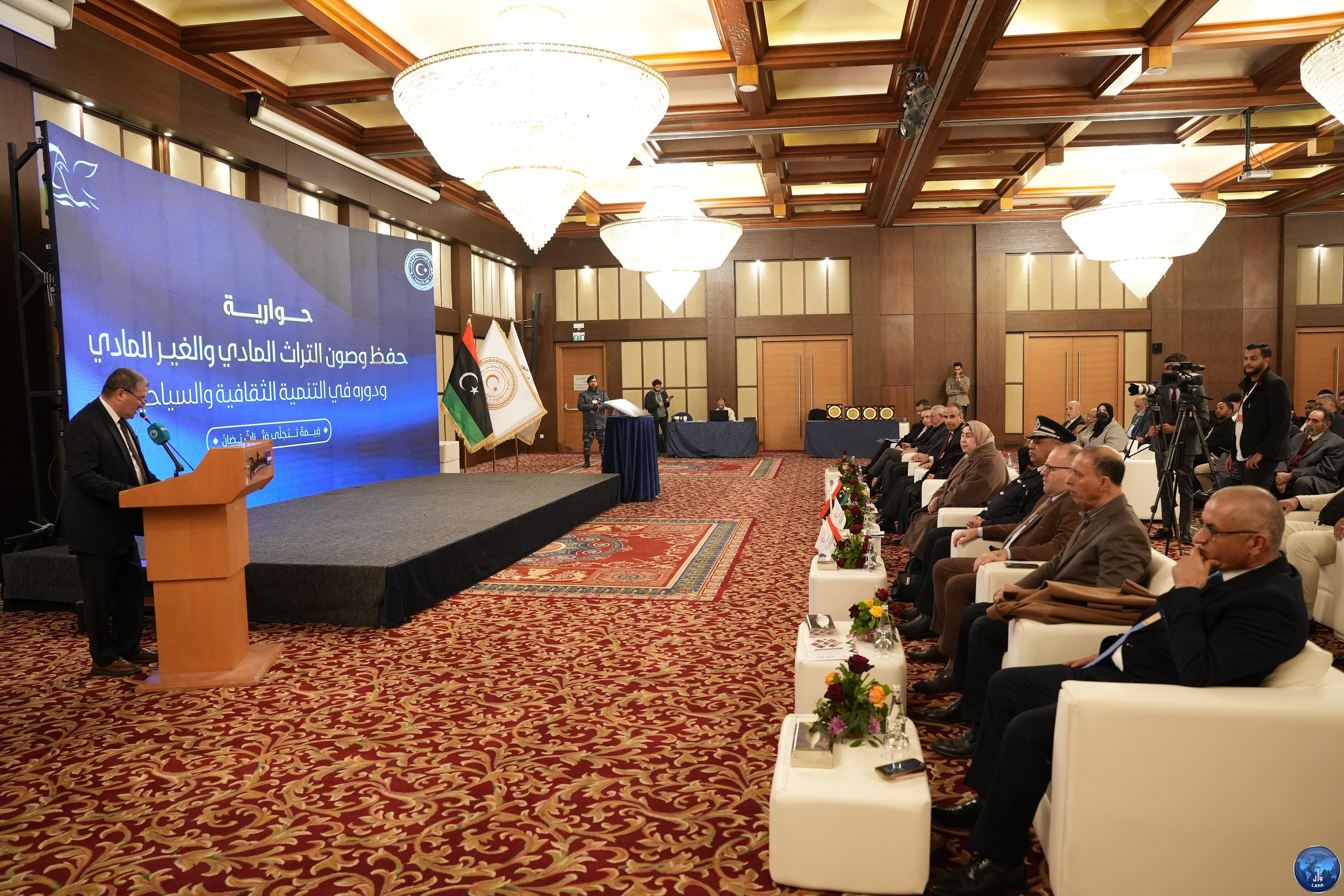
-Reporting by: Ismail Al-Kurbu
-Photography by: Fathi Shalfait
Tripoli, January 21, 2026 (LANA) – Minister of Tourism and Traditional Industries in the Government of National Unity, Nasr al-Din Milad al-Fazzani, affirmed that preserving and safeguarding tangible and intangible heritage is a developmental and economic responsibility and represents a fundamental pillar for supporting sustainable tourism and diversifying the national economy.
This came in his speech during a scientific dialogue organized by the Ministry of Tourism and Traditional Industries on Wednesday in Tripoli, entitled "Preserving and Safeguarding Tangible and Intangible Heritage and its Role in Cultural and Tourism Development," in the presence of a number of officials and those interested in cultural and heritage affairs.
Al-Fazzani said that Libyan heritage constitutes an integral part of the national identity and historical memory of the Libyan people, noting that the tourism sector is one of the vital sectors capable of transforming heritage into a real added value by integrating it into cultural and heritage tourism routes, which contributes to supporting the local economy and creating job opportunities, especially in areas of historical significance. He pointed out that the vision of the Government of National Unity is based on diversifying sources of income and reducing dependence on oil.
The Minister explained that the tourism sector witnessed a gradual recovery and growth during 2024 and 2025, with domestic tourism recording growth rates ranging between 20 and 30 percent. Accommodation facilities received more than 400,000 guests during the 2025 tourist season, generating revenues exceeding one billion Libyan dinars. There was also a noticeable increase in the number of visitors to archaeological sites and cities.
During the dialogue, Sumaya Osman, a heritage expert at the Ministry of Tourism and Traditional Industries, announced the launch of the National Register of Tangible and Intangible Heritage. She explained that national registers are an essential tool for protecting cultural identity and preserving collective memory by documenting and systematically recording heritage elements to ensure their preservation for future generations.
In a statement to the Libyan News Agency (LANA), she confirmed that the register project aims to inventory and classify heritage elements throughout the country, provide a comprehensive national database for researchers and stakeholders, enhance local community participation in cooperation with relevant authorities, support heritage as a tourist and development attraction, and pave the way for its registration with regional and international organizations.
The expert revealed that the village of Tounine in Ghadames has been registered in the architectural, urban, and tourism heritage register. She added that several other landmarks have also been registered, including the Al-Farjani Zawiya in Al-Khums, the Judge's Courtyard, and the Clock Tower in Tripoli's Old City. Furthermore, she noted the registration of several intangible heritage elements, such as kohl (a type of eyeliner) and traditional games, with work continuing on other files, including traditional pottery and couscous.
Osman presented an overview of the National Registers Project, explaining that it aims to inventory and classify heritage elements throughout the country, provide a comprehensive national database for researchers and interested parties, enhance local community participation, and support heritage as a tourist attraction and development tool.
For his part, Khader Bashir, former head of the General Authority for Tourism, emphasized in a statement to the Libyan News Agency the importance of dialogue in promoting Libyan tangible and intangible heritage and the necessity of registering it locally, nationally, and internationally. He pointed to the role of these efforts in preserving cultural heritage and transmitting it to future generations.
For his part, the head of the General Authority for Cinema, Theater, and Arts, Abdul Basit Abu Qanda, stated to the Libyan News Agency (LANA) that the launch of the tangible and intangible heritage registers is an unprecedented achievement. He explained that these registers will contribute to documenting cities, sites, and historical landmarks, as well as customs, traditions, and arts, thus strengthening efforts to register them at both the regional and international levels.
Ali Saleh Amer, Director of the Media and Communication Office at the Ministry of Tourism and Traditional Industries, explained that launching the national register represents a pivotal step in documenting heritage elements, supporting cultural tourism, creating opportunities for sustainable economic development, supporting artisans, and showcasing national and international experiences in this field.
The dialogue concluded by emphasizing the importance of developing practical and implementable recommendations that contribute to supporting efforts to protect and preserve Libyan heritage, enhancing its role in tourism and cultural development, and achieving economic diversification.
...(LANA)...