


Al-Lafi reaffirms the Presidential Council's commitment to supporting the comprehensive national reconciliation process.
Pulbished on: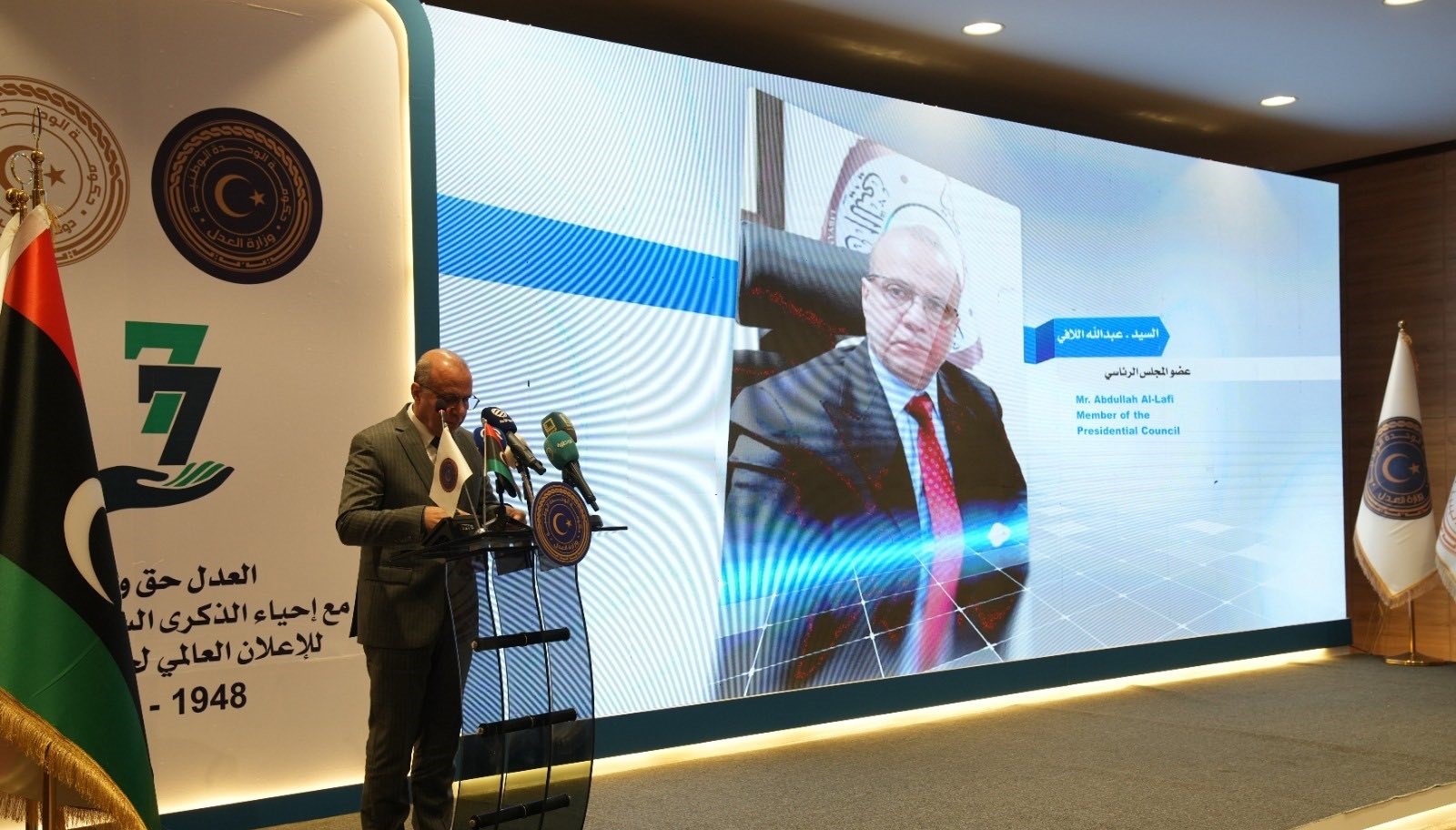
Tripoli, December 9, 2025 (LANA) – Presidential Council member Abdullah Al-Lafi reiterated the Council's commitment to supporting the comprehensive national reconciliation process, strengthening the human rights system, and building a new social contract that makes respect for freedoms and equality the cornerstone of a just state where every citizen feels protected by the law and treated fairly by the state.
In a speech delivered at a ceremony organized by the Ministry of Justice on Tuesday to commemorate the 77th anniversary of the Universal Declaration of Human Rights, he stated that Libya, as it recovers its political and social well-being, recognizes that there can be no stability without justice, and no justice without rights. He added that countries that neglect human rights open the door to division and conflict, while respecting rights paves the way for civil peace, development, and stability.
He emphasized that protecting freedoms, providing redress for victims, redressing grievances, and preventing impunity are essential conditions for the success of any political process or national reconciliation. He pointed out that the issue of victims, martyrs, and missing persons is central to the national process, not peripheral to it.
Al-Lafi emphasized that the rule of law can only be established with an independent judiciary, disciplined security institutions, and legislation that protects citizens from abuse and guarantees equality without discrimination. He pointed out that freedom is not chaos, but rather the framework through which society corrects its course and from which the state derives its legitimacy.
The Presidential Council member affirmed that all people are born free and equal before the law, and that this principle is not merely rhetorical but a foundational text that has contributed to establishing modern justice systems. He stressed that human dignity is a principle that precedes the state and the law and must guide the work of every authority and institution.
It is worth noting that International Human Rights Day represents an occasion to renew commitment to the human values upon which civil peace and the rule of law are based, and an opportunity to review the steps taken to further develop the performance of institutions and support the path of rights and freedoms in a manner that aligns with citizens' aspirations and meets the requirements of a modern state.