


The Information Authority and the UNDP review the Human Development Report 2025 and launch the seventh national edition.
Pulbished on: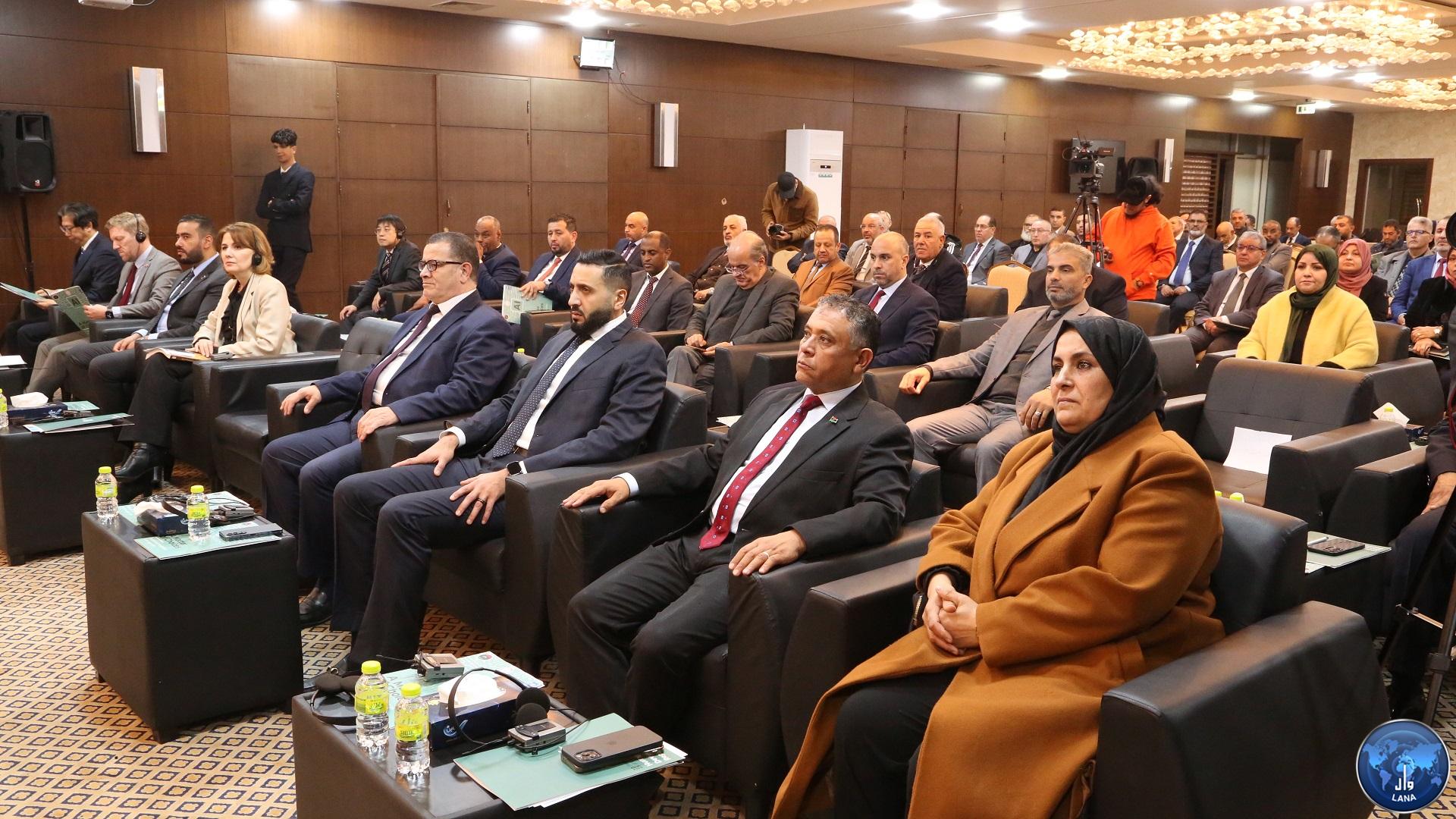
Reporting by: Ismail Al-Kurbu - Photography by Fathi Shalfait
Tripoli, December 8, 2025 (LANA) – The General Information Authority, in cooperation with the United Nations Development Programme (UNDP), presented the integrated framework for Libya's Seventh National Human Development Report, under the theme "National Vision and International Credibility," during a ceremony organized by the Authority in Tripoli on Monday to mark the release of the 2025 Human Development Report.
The ceremony was attended by the Chairman of the General Information Authority, Abdul Basit Al-Baour; the UNDP Resident Representative in Libya, Sophie Kimkhadze; undersecretaries from the Ministries of Education, Social Affairs, Economy, and Planning; the Head of the Statistics and Census Authority; the British and Korean Ambassadors to Libya; heads of several government institutions; representatives from government agencies; development experts; civil society organizations; and representatives of international organizations operating in the country.
The framework of the Seventh National Human Development Report, prepared by the General Information Authority with support from the UNDP, addresses the state of human development in Libya in light of the challenges of recent years. It provides an analytical overview of health, education, and income indicators, as well as the impact of digitalization and technological infrastructure on driving development. Dr. Mohamed Al-Hamali, head of the research team for the Seventh National Human Development Report, presented an overview of the integrated framework and methodology that will be adopted for preparing the upcoming national report.
During the event, the 2025 Human Development Report, themed "People and Potential in the Age of Artificial Intelligence," was reviewed. The report confirmed that Libya remains within the high human development category, ranking 115th out of 193 countries with a Human Development Index (HDI) score of 0.721 for 2023. It noted a clear strength in income indicators, while the health and education sectors were negatively impacted by fluctuating service provision in recent years.
The report indicated that Libya is ahead of several countries in the region, such as Morocco and Egypt, and has realistic opportunities to move into the very high human development category if it continues to invest in human capital and strengthens its education and health systems.
In his address at the workshop, the head of the General Information Authority, Abdul Basit Al-Baour, emphasized that it was being held as part of a partnership between the Authority and the United Nations Development Programme (UNDP) to review the 2025 Human Development Report, which addresses the impact of artificial intelligence (AI) on human development in the digital age.
He explained that the Authority is currently preparing Libya's seventh Human Development Report for 2025, titled "The Impact of Artificial Intelligence on Human Development in Libya: Prospects and Aspirations." He noted that the report is being prepared according to internationally recognized scientific methodologies, with the participation of more than 17 researchers and specialized data collection committees, in partnership with all government sectors in Libya.
Al-Baour stated that the first phase of research and studies has been completed and that a UN expert is currently reviewing the methodology in collaboration with the national team.
He indicated that the report is expected to provide a roadmap for human development in Libya, given the increasing reliance on digitalization as a fundamental element impacting educational, economic, social, and health sectors. He confirmed that the report's key features will be released at the beginning of 2026.
The head of the authority concluded his statement by emphasizing that the goal of these efforts is to support decision-makers with accurate data and to build knowledge-based policies that serve the Libyan people and elevate them to the level of developed nations in the field of human development.
For her part, the Resident Representative of the United Nations Development Programme in Libya, Sophie Kimkhadze, affirmed in her remarks that the new report comes at a time when the world is witnessing rapid transformation due to artificial intelligence and the challenges and opportunities it presents to developing countries.
She explained that human development revolves around expanding individuals' capabilities and empowering them through education, health, and active participation, noting that technological progress does not automatically translate into development but rather depends on sound policies and good governance.
Kimkhadze noted that the global report reveals a widening gap between countries despite the rapid pace of innovation, emphasizing that effective management of modern technologies can contribute to enhanced transparency and improved services, provided there are strong institutions and appropriate strategies in place.
She stated that Libya remains within the high human development category and possesses significant opportunities for faster progress, thanks to its large youth population and increasing technology adoption, despite the impact of instability on the health and education sectors in recent years.
She added that the launch of the seventh national report, led by the General Information Authority, represents a pivotal step in examining the country's development trajectory within the context of digital transformation. She commended the Authority's efforts in engaging universities and experts and ensuring the report's preparation based on reliable data and scientific analysis.
She explained that the Libyan experience benefits from regional expertise, including the experiences of Algeria, Iraq, and Egypt in data management, promoting community participation, and building trust in institutions.
Kimkhadze affirmed that the report's focus on artificial intelligence aligns with Libya's priorities, particularly in modernizing public administration, creating new opportunities for youth, and strengthening digital governance. She expressed the UNDP's readiness to continue providing technical and knowledge-based support, ensuring full national ownership of the report's preparation process.
Dr. Salima Ben Qaddara, a faculty member at the University of Benghazi specializing in information security and educational technology, told the Libyan News Agency that she is participating in the preparation of the Sustainable Development Report 2025–2030 as part of the team focused on digital governance, digital justice, and community participation.
Dr. Ben Qaddara explained that this focus addresses the infrastructure for digital transformation in Libya, including the digital divide, communication networks, and disparities in technological services between cities and regions.