


The Department of Antiquities Receives a Historical Mirror from the Era of Yusuf Pasha al-Qaramanli.
Pulbished on: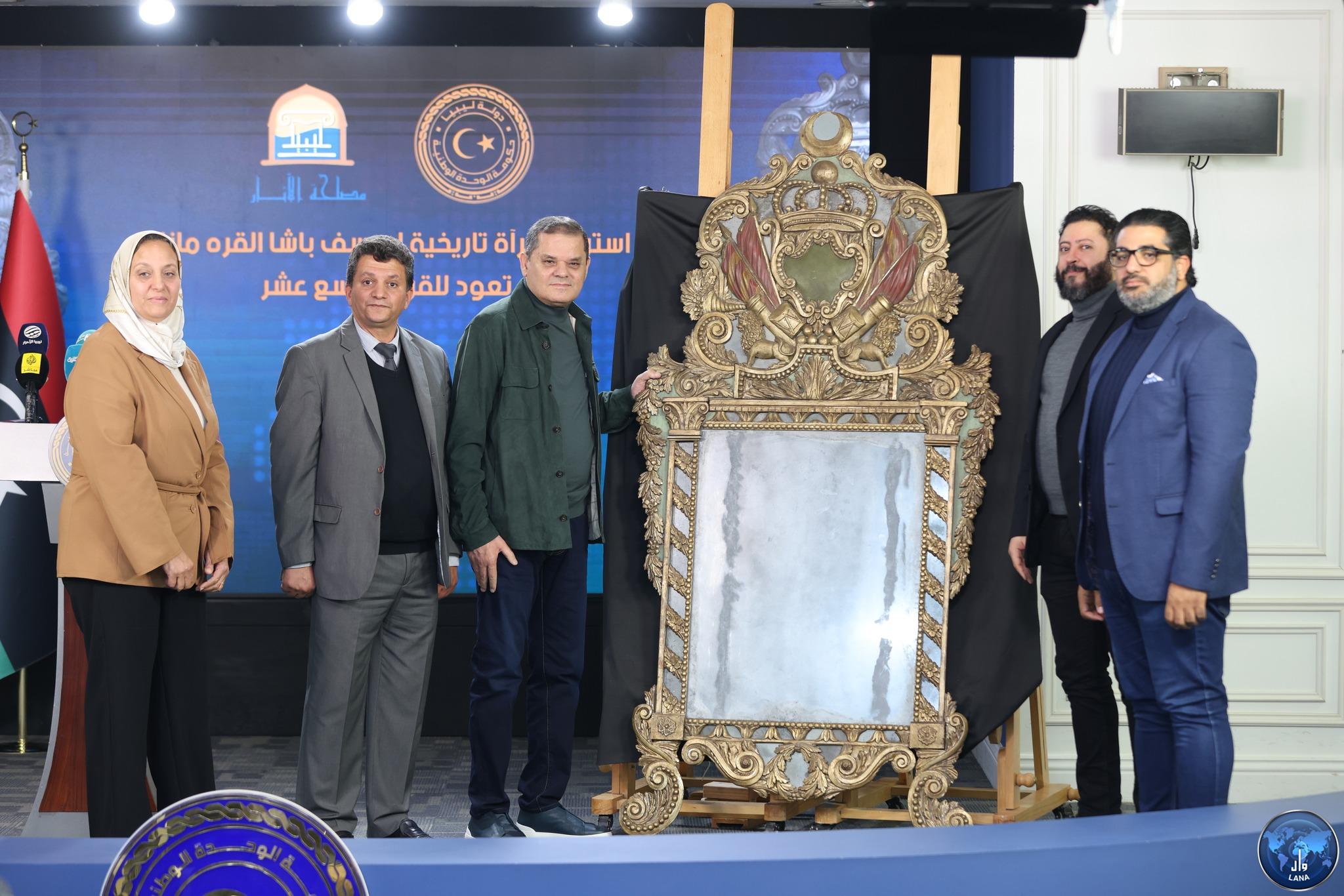
Tripoli, December 4, 2025 (LANA) – The Libyan Department of Antiquities received today, Thursday, a rare historical mirror dating back to the era of Yusuf Pasha al-Qaramanli (1795–1832), in the presence of the Prime Minister of the Government of National Unity, Abdelhamid Dbaiba. The mirror was recovered through the efforts of the team behind the historical drama series "Al-Saraya," which documented the Qaramanli rule from 1711 to 1835.
The meeting was attended by Ferial Sharaf al-Din, a member of the Department of Antiquities' management committee, as well as representatives of the historical drama series: writer Siraj Huwaidi and director Osama Rizq, along with a number of cultural figures, researchers, and historians, according to the government's media office.
Historical researcher Abdel-Muttalib Abu Salem pointed out that the mirror bears the emblem of the Qaramanli state, founded in 1711 by Ahmed Pasha al-Qaramanli. This state enjoyed independent rule, and the royal crown was part of its political symbol, along with the state flag, which featured alternating red and yellow stripes.
Abu Salem explained that the mirror was crafted in France in the Baroque style, imitating the styles prevalent in the courts and kingdoms of Europe at the time. This reflects the status of the Karamanli state and its diplomatic and cultural connections during that era, exemplified by the draft constitution of 1822 and the publication of the African Explorer newspaper in 1827.
Abu Salem added that this piece is not merely a luxurious artifact, but a symbol of the development of modern Libyan identity. It dates back to the early 19th century, a pivotal period in Libyan history, characterized by the establishment of governing institutions and the expansion of the Qaramanli state's international relations. In international treaties at that time, Libya was referred to as the Kingdom of Tripoli, which concluded peace and trade agreements with most European kingdoms.
For its part, the Department of Antiquities confirmed that the mirror, which it did not mention the entity from which it was recovered, will be displayed within the Qaramanli family wing at the Libyan National Museum, scheduled to open on December 12, to be one of the pivotal pieces that tell the story of the emergence of the Libyan state and the development of its historical symbolism.
=Lana=